Saturday, 19 September 2020

Woburn Walk


                            St Mary's Church Gargoyles

Today's walk I am told is going to be a little different ! We are off to a good start at least, ample free parking opposite St Mary's Church. Some friendly looking Gargoyles are smiling down on us from the church tower, on what is a pleasant sunny morning. We turn left along George Street leaving the lovely town centre behind us. 


The  route guide that we were using said that the walk was 8 miles. However a friend who completed it  recently came in at 11.7 miles. So we shall see ? We continue walking along the perimeter wall of what must be Woburn Abbey.We reach the entrance to the Deer Park at Ivy Lodge.   

We are now officially on the Woburn estate! As long as we stay the 'right' side of the yellow marker posts and don't deviate. Set within 3,000 acres of Deer Park, home to nine free roaming species of deer.The Red Deer and the Roe Deer are most prominent.include the Milu, or Pére David's Deer. Sika, Axis and Barasingha, and the rare and shy Rusa Deer. We might also see small Muntjac and Chinese Water Deer roaming freely.

I did venture onto the bridge that takes you towards the driveway. The Park was landscaped in the 19th century by Humphrey Repton, and stayed largely unchanged. The magnificent ancient trees and ornamental ponds make for a spectacular vista.Near basin pond is a tree known as 'Abbots Oak' said to be where Abbot Robert Hobbes was hanged. All part of the dissolution of the monasteries under Henry VIII.

We exit the Park after passing a lover Tudor style building to our right. We meet six other walkers coming the opposite way. They know the route well and warn of how muddy the next part of the route becomes in the winter. But today it is fine and we make good progress through a mixture of woodland and open fields to the village of Eversholt.   The village name means 'wood of the Boar' be great to see one !


Blue plaque to Frank Wild
Eversholt Cricket Pitch

Eversholt is a pretty village with a Village Hall overlooking the cricket pitch. The village pub 'The Green Man' is just opening as we arrive. We stop for a break , a refreshing pint of Blackpit Ruby Ale 3.7% goes down well. Brewed on the North Bucks and South Northants border at Stowe. 

The pub is leased by former 'Bake off'' winner Candice Brown. 


The Domesday book of 1086 lists Hugh de Beauchamp as Lord of the Manor for Eversholt whose descendants owned property there until the 13th century when the land passed to Woburn Abbey.  

Entering the village I notice a blue plaque on the wall to Frank Wild 1873 - 1939. An English sailor and explorer.e participated in five expeditions to Antarctica during the Age of Antarctic Exploration. Originally from the North Ridings in Yorkshire his family moved to the area and was educated at Bedford. He was regarded as Shackleton's right hand man on the 'Endurance' that sailed to Antarctica in 1914. 

Leaving Eversholt we pick up the Woburn Road and go up a steep road in the direction of Froxfield. This takes us back into the Deer Park again. A few confused safari park drivers seem a bit lost and ask for directions.Taking a sharp right it's a case of following the marker posts again. We find a good place for our pic-nic. 

The path will again take us close to the perimeter fence of the park.


Safari Park in the distance


Right against the fence was a Black Bear ! Quite a way from the circling cars of the visitors. In the far distance there are Elephants. I try and get a closer look while avoiding the CCTV cameras scattered around.I'm so focused on the horizon I don't see the huge pair of antlers rising out of the ferns....


A huge Deer is just a few yards ahead , I don't want to upset it so back away very cautiously. 

Following the path we go over a cattle grid and exit the Deer Park . We turn left through a lovely wooded area . Lots of interesting Fungi around at this time of the year as we move into Autumn. 

We exit the woods to the entrance of the safari park. A couple of inquisitive Zebras come for a closer look.

To the left is the entrance to the Safari Park so walk towards it & then turn right down the road past an old red Telephone Box. I notice that it is now £26.99 fee for an adult. Seems expensive , however the upkeep of the park must be colossal. 

Seems today we are going to see a lot of it for free.


There are two huge lion statues marking the entrance.First opened in 1970 as a means to help improve the financial position of the estate & restore the Abbey, which had fallen into disrepair.

The Safari Park itself covers 360 acres (150 ha).The park lets animals roam freely while visitors drive through their enclosures.


The path runs between the road you drive around the Safari Park on and the elephant (Asian) enclosure. Further behind two white Rhinos show some interest in the passing cars. We see various other animals including Giraffes, Ostrich and Bactrian Camels.  We leave through a gate into a shady wooded area, but still the animals can be seen. To our left is an enclosure with Wallabies of various shapes , size and colour. This is also the 'Go Ape' area where the public can have a treetop adventure on zip wires. 

Sadly we are nearing the park exit and arrive at the huge gates. There is nobody around and the gates seem to be locked.....This is not looking good. 

Fortunately despite their size there is a knack to opening them and with no small amount of relief we cross the main road and turn first left up Horsepool Lane.From here on it is largely fields all the way back to Woburn.


It's still lovely and warm and sunny and we finish off our picnic. 

The excitement hasn't quite finished as we have a bit of a run in with a log cutting vehicle that blocked the path. The operator it seemed didn't believe in stopping for walkers .Clearly no health and safety ethics....

Finally the path turns left to Birchmoor Green.


We pass through a small hamlet of houses on our right . One of which had this old fashioned washing wringer outside. A bit of local history as it originate from 'Gibson Andrews' of  Woburn.

Sadly as we near the end of the lane there is the horrible sight of fly tipping. It seems so prevalent now more than ever and is a complete eyesore.

It is something that blights our beautiful  countryside and completely disgraceful. If I had a pound for all the tyres I've seen dumped this Summer I would be a rich  man.


At the main road we turn left back in to Woburn and the re-assuring sight of my old friends the Gargoyles.

At the junction we turn left back into Park Street & to the car park where we started from. It's been a fantastic walk and according to my timing device 9.66 miles. I look forward to doing this walk again maybe late Autumn or Winter , who knows ?


 .


Saturday, 12 September 2020

Cider Making

Today's task is to convert the large supply of apples (pictured left) into a smooth golden brown liquid that will eventually become cider.

It is a mixture of different apple collected from various sources. As a general rule you  need in the region of 9 kg (20 lbs) of apples to produce 4.5 litres (1 gallon) of juice.
I definitely have several times that amount.

The ripest apples carry the best flavour and most juice.  I dont' think it matters too much if several of them are bruised and a bit brown , as long as they are not rotten.

Dessert apples are better , about 70% is ideal. Cooking apples provide the required acidity about 30%. You are looking for a pH reading in the region of 3.6 to 4.2 pH. I'm not that fussy as I've used a good quantity of cookers. We shall see !


Cidermaker's with 'Scratter'
One that didn't make the grade

 I've gone over to see an old friend of mine who has the all the gear needed, A pulper sometimes called a 'scratter' or  'Fruit crusher'. He also has a press to extract the juice.

I start to chop the apples as Simon starts to feed them through the pulper . It is actually a converted garden waste shredder. I quarter the apples,removing any bad bits. No need to be too fussy and the core and pips are fine.

When crushing, be careful not to over do it. The finished apples should have some substance to them, and liquid juice should not be present. If it is you have pulped them too much......


The Press
The crushed apples are then ready to be pressed.This will mean you only get the juice and you will leave all of the pulp behind.The pulp can the go on the compost heap or green bin.

From out of nowhere a few wasps have started to show a bit of interest. That's fines as long as long as they stick to the rotten and unwanted parts of the apples.

The press is turned down onto the fruit until you feel real tension. As soon as you do, don’t keep turning but leave this in position for a few minutes. You can see the juice start to run. When the juice stops then tighten again and leave.
The juice is captured in the large plastic bucket that is going to be used for the fermentation process.  

Once the last of the pulped apples have been pressed there is about 18 litres of juice collected.


It is at this stage that you can take a hydrometer reading of the juice. To do this, place the hydrometer in the juice and you will see a reading where the hydrometer is level with the liquid. You can then use this reading to work out how much alcohol will be present after fermentation.

To boost the gravity (strength) I will add a kilo of caster sugar. This will then turn to alcohol and make a stronger cider.
I will then leave to ferment at a temperature between 20-27°C for about 5 to 14 days or until the hydrometer is showing the fermentation has finished. A constant cool temperature is much better than one that fluctuates.

When the fermentation has finished (the gravity reading on the hydrometer will be the same for a few days and will be under 1000 SG) I will siphon/rack off into clean sterilised glass demijohn containers.

Friday, 11 September 2020

Walking The Ridgeway - Hackpen Hill, Winterbourne Monkton


Hackpen Hill
Amazingly our first venture onto The Ridgeway in 2020 ! This would most likely be the last as well, it being the last leg of the journey. It's a great pleasure to be out on this history laden path that has provided such a rich walking experience. We wouldn't need to go to the actual start/finish point as this had been covered on a previous visit to Avebury. So no Bunting or 21 gun salute to celebrate our achievement sadly.


Hackpen White Horse

Our starting point was right next to the chalk hill White Horse at Hackpen. On the edge of the Marlborough Downs 2 miles south east of Broad Hinton. One of nine white horse hill figures located in Wiltshire. Dating back to 1838 it is said to commemorate the coronation of Queen Victoria. The horse is 90 square feet (8.4 m2).
The expression "as different as chalk and cheese is sometimes believed to refer to the land divided by Hackpen Hill. The hill forms the boundary between the high chalk downs to the south of it and the clay cattle country to the north, where cheese is a product of the milk from the cattle. There is something quite fascinating about a White Horse carved in the hillside. There are apparently 17 white horse hill figures in England in total.

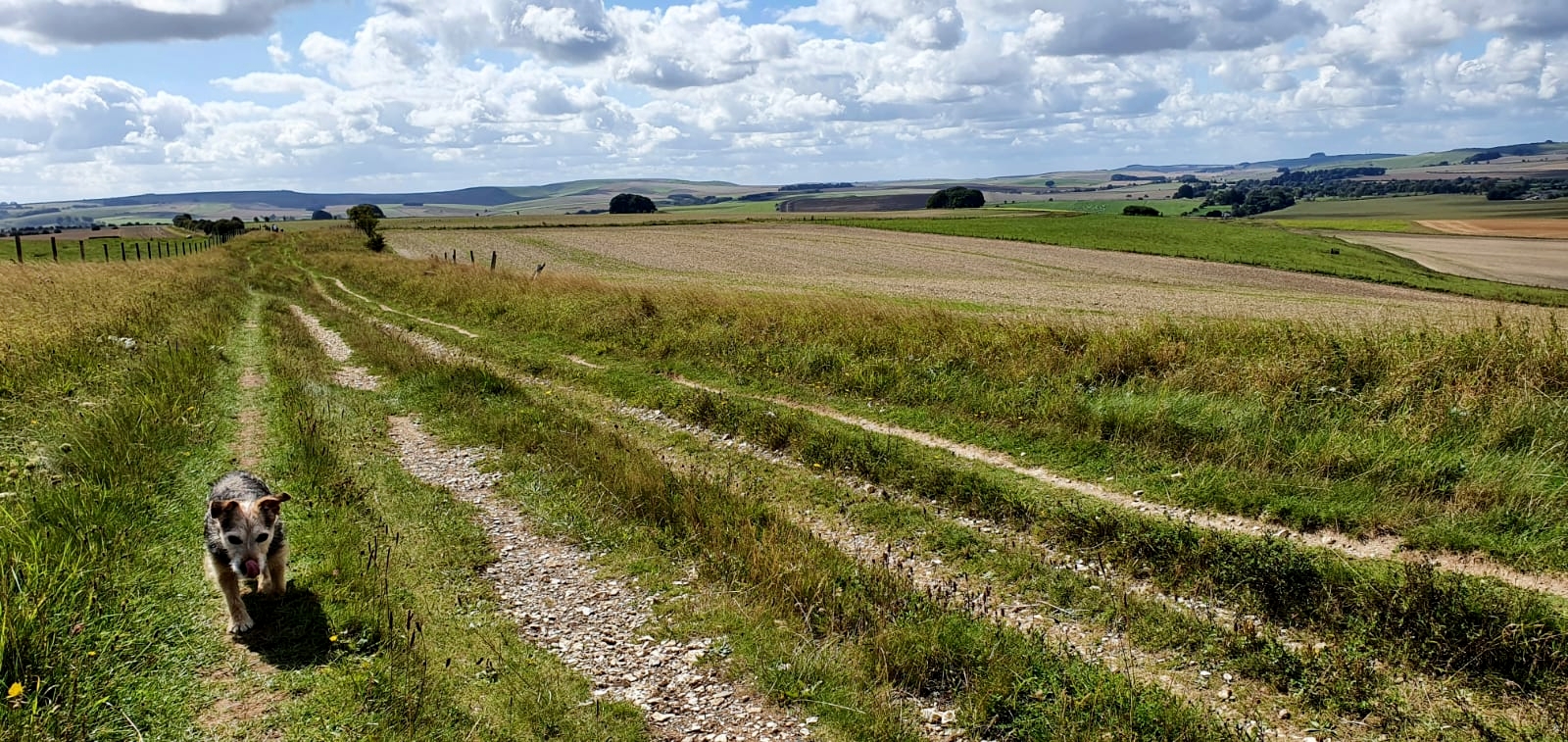
 It's the most perfect of days for a walk, a slight chill in the air as we start off. It quickly warms up and a layer or two of clothing is soon dispersed with. The views are spectacular, particularly to our right looking towards Avebury in the distance. We can even see the huge stones that line Kennet Avenue.   
There are a few other walkers and cyclists venturing out on what I would say is one of the most stunning parts of the whole Ridgeway.
There have been many highlights but for me this part of Wiltshire has some kind of mystic quality.
It is steeped in history and mystery that I can't get enough of . 

Little 'Archie' has walked every single step of The Ridgeway too, so great respect to him.
It is not surprising that the North Wessex Downs is a designated area of natural beauty. The area itself does have a variety of other names though.
The Berkshire Downs, The North Hampshire Downs, The White Horse Hills, The Lambourn Downs, The Marlborough Downs, The Vale of Pewsey and the Savernake Forest!The AONB covers an area of some 1,730 km2 (670 sq mi). It takes the form of a horseshoe, with the open end facing east, surrounding the town of Newbury.

 The northern arm reaches as far east as the suburbs of Reading and as far north as Didcot in Oxfordshire.
We stumble across a 'Dewpond' Berwick Bassett ,originally created to provide a source of fresh water for grazing sheep.They are actually fed by rainfall and were carefully sited so that water would naturally drain into them.
Although there may be between 30 to 40 inches of rain per year on the Downs, standing water is quite rare. The pond is now fenced in to prevent 4x4  drivers taking advantage.

A happy chap
The walk back towards the car park at Hackpen Hill was a steep one. The views are equally if not more spectacular. There are plenty of pheasants milling around and in secure enclosures. There are also a couple of copse like areas, with conifers and evergreens that seem to have been planted for some particular reason? If it hadn't involved clambering down a steep embankment then I would have inquired further. It might well have been been another area for pheasant breeding, who knows?


Avebury arrival


It' a great feeling to have finished The Ridgeway ,tinged with a little sadness.
 In total we have completed 22circular walks that got progressively longer. A distance of over 200 miles was covered.

To mark the occasion we head off to Avebury where we have a table booked at The Red Lion.


The famous Avebury stones


Avebury Manor is at the centre of the village next to St James Church. It is now owned by the National Trust and is open to the public, but not today along with the museum.

The stone circles are a national treasure of course. Why they are there is still open to speculation ,there are many theories.  To me it doesn't matter , they are something spectacular and magical.I have written more about their history in a previous blog write up.
http://peterja-storytellersnight.blogspot.com/2017/12/a-walking-tour-of-avebury.html


Now it is time to enjoy a tasty burger and a couple of pints of 'Soul Train' White Gold IPA !


Monday, 31 August 2020

Swanbourne -Swans Way (6)


On the Swans Way again in the North Bucks area of the Vale of Aylesbury. A little bit of road walking takes us to the village of Swanbourne. An Anglo Saxon name in origin, and possibly meaning "swan stream".

St Swithuns  Church is Anglican , a Grade II listed historic building, stands at the east end of the village, opposite Swanbourne House. We walk past the Primary school which has an interesting statue of two happy looking schoolchildren in the entrance.

Swanbourne War Memorial,  stands at the junction of Winslow Road and Mursley Road, Swanbourne, is also listed as Grade II.
The memorial is a Portland stone obelisk, c4m tall, which rises from a two-stage, moulded, plinth. Carved on the front face of the upper stage of the plinth, the principal dedication reads IN HONOUR OF THE MEN/ OF SWANBOURNE/ WHO SERVED THEIR KING/ AND COUNTRY IN THE/ GREAT WAR 1914-1918


Swanbourne War Memorial


Swallows gathering


It's nearing the end of August and Swallows are gathering on overhead lines. Won't be too long now before they are heading off for a warmer climate. It's a great time of the year as we start to move into Autumn. the hedgerows are packed with juicy Blackberries and Sloes. Plenty of Damsons and Plums too all fine to eat and very tasty.
We pass by the village of North Marston, 'Marston' is a common one in England, and is Anglo Saxon for 'Farm by a marsh'.


Fields of Sweetcorn
We spot our first Deer in the distance n not easy to tell  what it is though? Some nice scenery with the occasional pond. The one pictured  seemed to have it's own burial island.


North Marston


Plenty of rain lately so the streams are all full and flowing along quite nicely.

The next village we come to is 'Granborough . I'm sure you are anxious to know what that means in Anglo Saxon ? Well I can tell you that it means 'Green hill'.

The Village Hall stands in splendid isolation . I can't help thinking that it would make a splendid cricket pavilion.  Maybe in another life it will find it's vocation.

The village is still one of the possessions of the Crown.  Not surprisingly then that the pub in the village is therefore called 'The Crown'.


We had already had a close encounter with two horses which was a bit uncomfortable. Never a good thing when they come charging down the field at you . They seemed to take an instant dislike to little Archie the dog. He decided safest course of action was to hide behind me. Which then put me in the firing line.
I was extremely pleased to reach the gate the other side of the field.
More problems were to come in a field of cows who were equally intent on causing us stress.
This was supposed to be a relaxing walk as well.....

The food foraging continues as we pick some lovely red apples from an old orchard. We also pick some large field mushrooms too. There are a number of yellow/green/red coloured mushrooms too. This according to our  book are called 'Ruby Bolete'.

However the best sighting is yet to come. Walking through a field of Oats there is a scurrying that sound to be a bit more than the numerous pheasants we have seen.
I walk round the edge of the field just in time to see a 'Chinese Water Deer' come bounding out at a fair gallop. I was just glad that I wasn't in the way of it. It was very stocky more similar to a musk deer than a true deer. 
So many of the creatures have escaped from private collections and and mated that there are now more in the UK than China.

It has been a really good walk , plenty of free wild food , lots of wildlife and the weather stayed dry . In total we covered just over eleven miles.


Gary Numan - Northampton Roadmender (Night 2)

Tour Bus parked up Popped into town at lunchtime and called past the Roadmender just to see who was about. Two people (Ellie and Graham) wer...