Thursday, 12 October 2023

The Market Harborough Round (9) Kings Norton & Billesdon

Back over the border into deepest darkest Leicestershire. We are back in the village of kings Norton, with It's mighty impressive Church looming large in the background. For those who are interested today's walk will be in a clockwise direction. Reputedly to be a distance of 9.4 miles although it never quite works out like that. 

We are heading in the direction of Houghton on the Hill.A huge Bumblebee is feasting on the lush patch of flowering clover. The path takes us across several footbridges One of which provides safe passage over the River Sence. That does sound a bit grand though. With a bit of a run up I could probably have jumped it, knees permitting. It is actually a tributary of the much larger River Soar. The River Sence can be traced eastwards up to the village of Billesdon which get to in due course today. 


River Sence
St Catherine's Church

St Catharine's Church at Houghton on the Hill comes into view. The first mention of Houghton is in the Domesday Book in 1086 (spelt Hohtone) when it is recorded as having a population of 10. It has certainly grown a bit since those times. In the last Census of 2011 the total was 1548. Although in 2007 it was dubbed "the village of the scammed"following a major credit card fraud scam originating from the local petrol station. We continue our walk through one of the new housing estates that have arisen over the last few years. 

Ingarsby Medieval Village

From the new to the Old as we walk towards the deserted medieval village of Ingarsby. Before we reach it though we pass by the 'Monks Grave motte'. It's all getting very exciting. It is actually quite a small motte mound with a ring ditch, but with no bailey ditch.

Monk's Grave Motte


Field Mushrooms
Ingarsby is one of the best preserved medieval villages in England. The settlement was probably founded by a Danish individual named Ingwar and as such was referred to as 'Ingwar's village'. It would originate back to the 9th or 10th century, growing to become a substantial village. The Black Death is incorrectly usually assumed to be the cause of a deserted village. The desertion was for the far more common reason that sheep were much more profitable to the big religious establishments than people. Leicester Abbey turned the villagers out, and introduced sheep farming instead!The lush ground is a prime site for mushrooms though. Lots of large edible Field and Horse mushrooms. Meadows grazed by sheep, cattle or horses sometimes produce vast quantities of these fungi of summer and early autumn... but not every year, unfortunately. This year though promises to be a very good year. The same can be said for the red berries too The hedgerows are crammed with them. Good for the birds but a sign of a bad winter ahead perhaps?

This may be a bit controversial but I'm going to say it anyway. I think the Leicestershire countryside is better than we have in Northamptonshire. There I've said it now . There are exceptions of course but generally speaking Leicestershire seems more rolling and even greener.  


Rolling Hills

We are heading along the footpath to Botany Bay Fox Covert. We then pass through Billesdon Coplow and the surviving  house some 700 feet above sea level can be seen. The original estate was one of the classic hunting establishments of the Shires.The walk is not without it's jeopardy though. Passing a farm the path takes us through a paddock with horses. They wouldn't move away from the stile., showing us far too much attention. There was no other way but to cross the muddy paddock. I was worried that one swing of the giant neck and head and I'd be knocked over. Thankfully they seemed more inquisitive than aggressive and we crossed safely, albeit breathing a little heavier. 

In the next field a farmer was getting in the last of the Barley Harvest. From there on it was a straightforward walk through nice countryside to the village of Billesdon. The village's name either means 'the hill of Bil' or sword shaped hill.  Two fairs, annually on 23 April and 25 July, and a weekly Friday market, were granted in 1618.It has an olde worlde feel to it which I really like. Cattle fairs were held from 1846 until the early years of the 20th century. Leaving Billesdon we pass another deserted village. This time the medieval village of Frisby.  It was a settlement that part of the manor of Gaulby. There isn't a lot to see in truth aside from a few earthworks. We then pass through the small village of Gaulby as we near the starting point of our walk.  We aren't quite out of harms way as a very ferocious looking and well built Ram starts to pay us unwarranted attention. He is a big brute and no mistake. Thankfully he is happy enough just to usher off his manor so to speak. 

Parish Church of St Peter Gaulby

As we approach Kings Norton the re-assuring sight of the Church tells us that we are just about finished. A n interesting if at times perilous walk... These things are supposed to be relaxing I thought? 

As expected the total length of the walk comes in more than planned at 10.88 miles.


Monday, 9 October 2023

Houghton House English Heritage

Houghton House

Just enough time for a little stop off at another English Heritage property on the way home from Wrest Park.  

All that remains thee days is the shell of a 17th century mansion that commands magnificent views over the local countryside. The mansion was built in 1615 for Mary, Countess of Pembroke. It is a mixture of classical and Jacobean styles. It was reputedly the inspiration for the ‘House Beautiful’ in John Bunyan’s Pilgrim’s Progress.the ground floors of two Italianate loggias survive. A loggia is an outdoor corridor or gallery with a fully covered roof and an outer wall that is open to the elements.

In 1738 the 4th Duke of Bedford bought Houghton. His son, the Marquis of Tavistock, lived there from 1764 until he died in a hunting accident in 1767.


The 5th Duke of Bedford rented the hunting park to a neighbour. Subsequently unable to let the house without the park, he ordered Houghton to be dismantled in 1794. The interior was completely gutted, leaving no hint of its former glory.

In the early 1770s the Earl of Upper Ossory commissioned Lancelot 'Capability' Brown to landscape nearby Ampthill Park. He included Houghton House as a feature in the design though it lay outside the boundaries of his estate. Later, in 1804 the Earl acquired the park and the ruins of Houghton House. Today the house still dominates the landscape, providing wonderful views over its former hunting park.

Wrest Park - English Heritage

A little trip out into Bedfordshire to the English Heritage site of 'Wrest Park'. As well as the 18th Century mansion, there are also 90 acres of gardens and woodlands to explore. Plenty of follies hidden away in the grounds to find too.For over 600 years the estate was home to one of the countries leading leading aristocratic families, the 'De Grays'. In 1830  Thomas, Earl De Gray, rebuilt the house laying out formal gardens. During the First World War it was used as a hospital.First things first though as we have a wander around the house.  


I couldn't resist trying on an Army jacket and cap inside the house. It was encouraged, although I do look  a little sheepish.. The most striking part of the house for me is the magnificent Staircase Hall. Reaching the full height of the building the twin branches of the staircase draw the eye upwards to the family portraits adorning the walls. Other rooms include; the Entrance Hall, Ante - Library, Drawing Room, Sitting Room, Conservatory and Dining Room. I'm keen to get outside though and start exploring the grounds.

Chinese Temple and Bridge

Walking through the woodland the first point of interest is the Chines Temple and Bridge. Created somewhere between 1758 and 1761.The bridge has been rebuilt several times, lastly in stone in 1876 by Earl De Gray's daughter    Anne Florence Cowper. We pass by the Ladies' Lake with its statue of Diana and a Greyhound.  

I was a little disappointed with the 'Capability' Brown Column in truth. It commemorates his modification of the gardens in 1758-60. It was moved in 1828 to the present location at the north end of the Lady Duchess's Walk from the Bath house garden.  I suppose I was expecting something a little more grander given the reputation and work of 'Capability' Brown who seems to have been involved in so many projects.  

 Dog's Cemetery

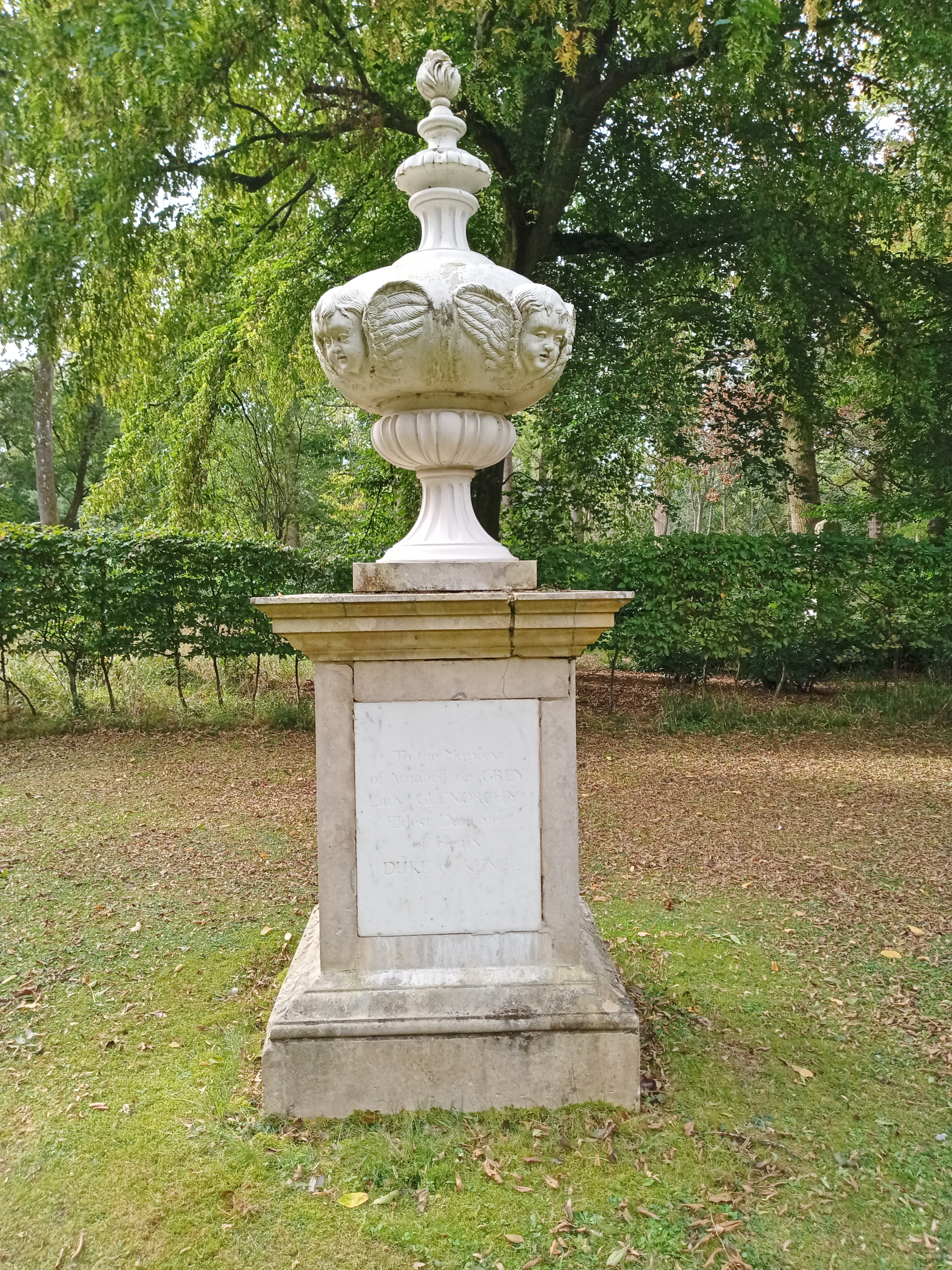
In 1829, Thomas, 2nd Earl De Gray erected the Dog Monument, a statue of a dog on a stone pedestal.Many of the family's pets went on to be buried in this clearing in the woodland garden. These include 'Dorroch' the favourite dog of Aldine Cowper, and 'Little Dick', favourite of her sister Amabel.  There are 16 surviving headstones that date from 1830 to 1891. Although the majority are not in their original positions. 

Pet cemeteries were quite common features in country house gardens in the early Victorian period. It was the start of a shift in attitude towards animals and that affection held for them. We cut through to the impressive sight of the 'Long Water' encased on either side by walkways leading to the spectacular Archer Pavilion. Built by Thomas Archer between 1709-11.

Long Water
Pavilion

I'm quite enjoying ticking off the monuments as we wander around the gardens I must say. Something quite satisfying that appeals to my sense of order.  The Archer Pavilion is one of the crown jewels to see no doubt. It really is a geometrical  delight! From the outside it is quite misleading.Once inside the central room, three small and narrow spiral staircases lead to three small upper chambers, which cannot be seen from the outside of the building.There is also a basement with a kitchen, larder, bath and two-seater privy. Inspiration for the pavilion’s plan may have come from Michelangelo’s designs for San Giovanni dei Fiorentini in Rome.The central dome is equally as stunning,  reminding me of a mini version of the great Basilica in Florence. There is no doubt that it is a magnificent example of a Baroque style building. The statue in front of the Pavilion is of William III dressed as a Roman Emperor.

Mithraic Altar

We start to make the turn back towards the other side of the woodlands. Following the 'U' shaped river that provides a boundary to the estate. There are ripples in the water, several large Carp appear searching for a morsel. A tree is riddled with Mistletoe, I've rarely seen it a such a low level. The berries are still at the green stage but will eventually turn white. Leaving the path we discover the Mithraic Altar built in 1748 and made of stone and flint. Something of an elaborate intellectual joke of literally endeavour I'm told. Probably best to leave it there I think... 

Nothing like a friendly game of Bowls on a nice day. I think my style was good, even if the end result wasn't quite so good. Bowling Green house may have been built as a early as 1720-21. Inside it is richly decorated with a marble chimney-piece. We continue our walk through the 'Evergreen Garden. Previously known as the 'American Garden' due to the acid loving plants usually found in North America. 

At the centre of the garden is a statue called 'The Hawking Party' . It was made by the Irish Sculptor Terence Farrell. It was originally a horse and was intended for the stable block. A lady was with a Hawk was later added with a Page by her side. There are some nice views of the House as we approach from the other side. The last port of call before seeking out the comforts of the Cafe is the Orangery.  The days when it was stocked with French Orange trees are long gone. Supplied by King Louis Philippe of France himself. By the end of the 19th century there were said to be the largest in the country. They were wheeled out through concealed doors onto the slopes below. The Orangery itself was built in the late 1830's to a French style. 

The Bath House

The Bath House to be my favourite amongst the many statues and follies to visit. Surrounded by water with a natural spring was built between 1769 and 1771. They were very fashionable in Georgian gardens I'm told. Especially as Doctors recommended regular cold baths for health benefits. Very good for dealing with cases of Gout which were prevalent in the aristocracy. Too much rich living no doubt. A fitting end to a very enjoy wander around the grounds and gardens.

Gary Numan - Northampton Roadmender (Night 2)

Tour Bus parked up Popped into town at lunchtime and called past the Roadmender just to see who was about. Two people (Ellie and Graham) wer...