Monday, 9 October 2023

Houghton House English Heritage

Houghton House

Just enough time for a little stop off at another English Heritage property on the way home from Wrest Park.  

All that remains thee days is the shell of a 17th century mansion that commands magnificent views over the local countryside. The mansion was built in 1615 for Mary, Countess of Pembroke. It is a mixture of classical and Jacobean styles. It was reputedly the inspiration for the ‘House Beautiful’ in John Bunyan’s Pilgrim’s Progress.the ground floors of two Italianate loggias survive. A loggia is an outdoor corridor or gallery with a fully covered roof and an outer wall that is open to the elements.

In 1738 the 4th Duke of Bedford bought Houghton. His son, the Marquis of Tavistock, lived there from 1764 until he died in a hunting accident in 1767.


The 5th Duke of Bedford rented the hunting park to a neighbour. Subsequently unable to let the house without the park, he ordered Houghton to be dismantled in 1794. The interior was completely gutted, leaving no hint of its former glory.

In the early 1770s the Earl of Upper Ossory commissioned Lancelot 'Capability' Brown to landscape nearby Ampthill Park. He included Houghton House as a feature in the design though it lay outside the boundaries of his estate. Later, in 1804 the Earl acquired the park and the ruins of Houghton House. Today the house still dominates the landscape, providing wonderful views over its former hunting park.

Wrest Park - English Heritage

A little trip out into Bedfordshire to the English Heritage site of 'Wrest Park'. As well as the 18th Century mansion, there are also 90 acres of gardens and woodlands to explore. Plenty of follies hidden away in the grounds to find too.For over 600 years the estate was home to one of the countries leading leading aristocratic families, the 'De Grays'. In 1830  Thomas, Earl De Gray, rebuilt the house laying out formal gardens. During the First World War it was used as a hospital.First things first though as we have a wander around the house.  


I couldn't resist trying on an Army jacket and cap inside the house. It was encouraged, although I do look  a little sheepish.. The most striking part of the house for me is the magnificent Staircase Hall. Reaching the full height of the building the twin branches of the staircase draw the eye upwards to the family portraits adorning the walls. Other rooms include; the Entrance Hall, Ante - Library, Drawing Room, Sitting Room, Conservatory and Dining Room. I'm keen to get outside though and start exploring the grounds.

Chinese Temple and Bridge

Walking through the woodland the first point of interest is the Chines Temple and Bridge. Created somewhere between 1758 and 1761.The bridge has been rebuilt several times, lastly in stone in 1876 by Earl De Gray's daughter    Anne Florence Cowper. We pass by the Ladies' Lake with its statue of Diana and a Greyhound.  

I was a little disappointed with the 'Capability' Brown Column in truth. It commemorates his modification of the gardens in 1758-60. It was moved in 1828 to the present location at the north end of the Lady Duchess's Walk from the Bath house garden.  I suppose I was expecting something a little more grander given the reputation and work of 'Capability' Brown who seems to have been involved in so many projects.  

 Dog's Cemetery

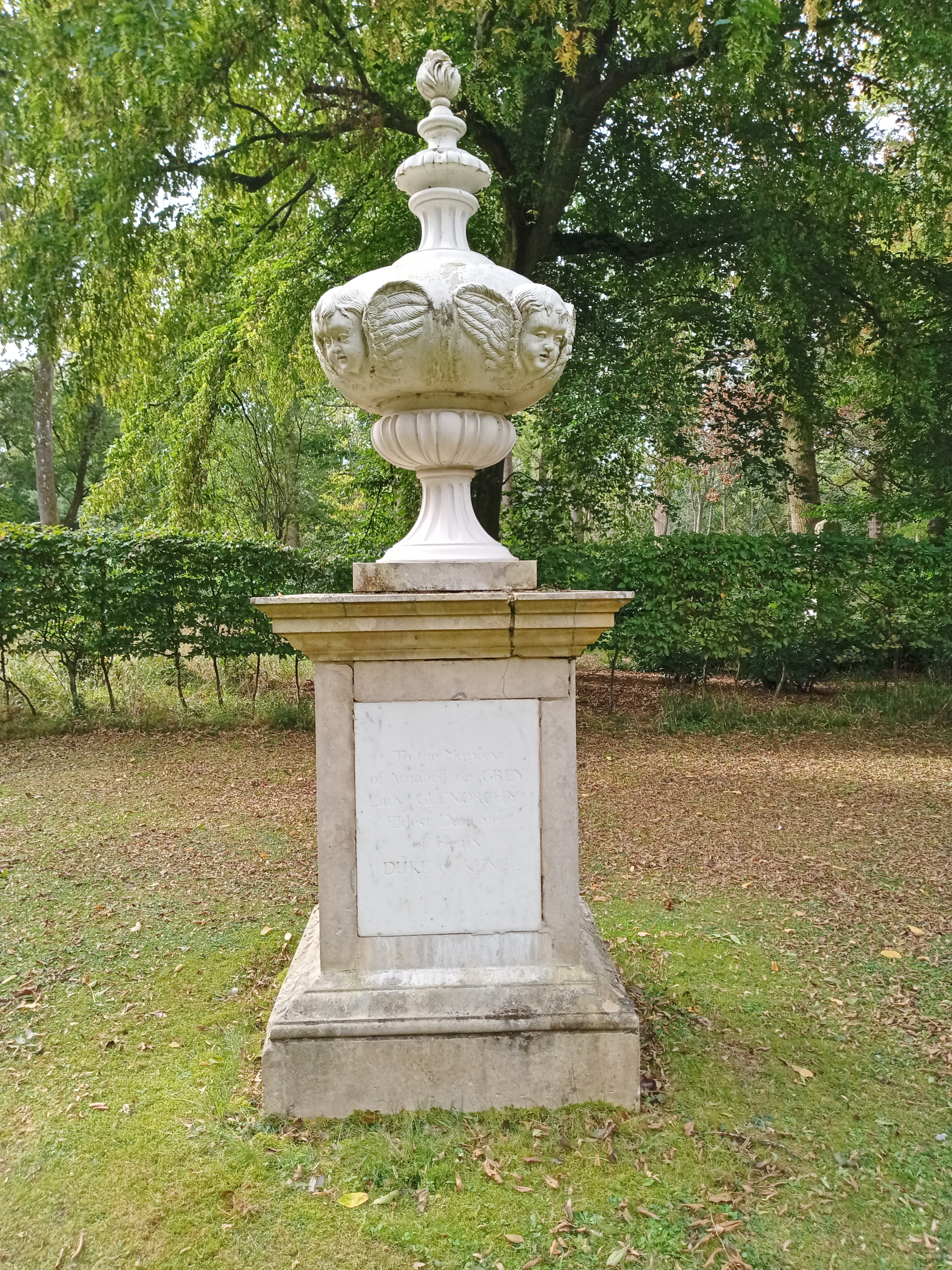
In 1829, Thomas, 2nd Earl De Gray erected the Dog Monument, a statue of a dog on a stone pedestal.Many of the family's pets went on to be buried in this clearing in the woodland garden. These include 'Dorroch' the favourite dog of Aldine Cowper, and 'Little Dick', favourite of her sister Amabel.  There are 16 surviving headstones that date from 1830 to 1891. Although the majority are not in their original positions. 

Pet cemeteries were quite common features in country house gardens in the early Victorian period. It was the start of a shift in attitude towards animals and that affection held for them. We cut through to the impressive sight of the 'Long Water' encased on either side by walkways leading to the spectacular Archer Pavilion. Built by Thomas Archer between 1709-11.

Long Water
Pavilion

I'm quite enjoying ticking off the monuments as we wander around the gardens I must say. Something quite satisfying that appeals to my sense of order.  The Archer Pavilion is one of the crown jewels to see no doubt. It really is a geometrical  delight! From the outside it is quite misleading.Once inside the central room, three small and narrow spiral staircases lead to three small upper chambers, which cannot be seen from the outside of the building.There is also a basement with a kitchen, larder, bath and two-seater privy. Inspiration for the pavilion’s plan may have come from Michelangelo’s designs for San Giovanni dei Fiorentini in Rome.The central dome is equally as stunning,  reminding me of a mini version of the great Basilica in Florence. There is no doubt that it is a magnificent example of a Baroque style building. The statue in front of the Pavilion is of William III dressed as a Roman Emperor.

Mithraic Altar

We start to make the turn back towards the other side of the woodlands. Following the 'U' shaped river that provides a boundary to the estate. There are ripples in the water, several large Carp appear searching for a morsel. A tree is riddled with Mistletoe, I've rarely seen it a such a low level. The berries are still at the green stage but will eventually turn white. Leaving the path we discover the Mithraic Altar built in 1748 and made of stone and flint. Something of an elaborate intellectual joke of literally endeavour I'm told. Probably best to leave it there I think... 

Nothing like a friendly game of Bowls on a nice day. I think my style was good, even if the end result wasn't quite so good. Bowling Green house may have been built as a early as 1720-21. Inside it is richly decorated with a marble chimney-piece. We continue our walk through the 'Evergreen Garden. Previously known as the 'American Garden' due to the acid loving plants usually found in North America. 

At the centre of the garden is a statue called 'The Hawking Party' . It was made by the Irish Sculptor Terence Farrell. It was originally a horse and was intended for the stable block. A lady was with a Hawk was later added with a Page by her side. There are some nice views of the House as we approach from the other side. The last port of call before seeking out the comforts of the Cafe is the Orangery.  The days when it was stocked with French Orange trees are long gone. Supplied by King Louis Philippe of France himself. By the end of the 19th century there were said to be the largest in the country. They were wheeled out through concealed doors onto the slopes below. The Orangery itself was built in the late 1830's to a French style. 

The Bath House

The Bath House to be my favourite amongst the many statues and follies to visit. Surrounded by water with a natural spring was built between 1769 and 1771. They were very fashionable in Georgian gardens I'm told. Especially as Doctors recommended regular cold baths for health benefits. Very good for dealing with cases of Gout which were prevalent in the aristocracy. Too much rich living no doubt. A fitting end to a very enjoy wander around the grounds and gardens.

Monday, 25 September 2023

Welford Reservoir Autumn Equinox Walk

It's the first day of Autumn and the sun is shining. a perfect day to get out for a walk. It has been a quiet month for walks really, not helped by a bout of Covid which laid me low for a while. Plenty of bike rides though, managing at least a hundred miles per week. So I'm fully fit and raring to go. The starting point today is 'The Wharf'' at Welford marina. A former important Stagecoach stop right on the border between Northampton and Leicester. According to the board in the car park there are 6 local walks that can be done. The one I'm doing today will take me across Welford and Sulby Reservoir up to Sibbertoft. I'm also expecting a mixture of mixture of hard tracks, fields & paths with the odd surprise no doubt. Leaving the car park I cross a small wooden bridge into the lovely little Pocket Park. Postman Pat and his Black and White Cat  are also enjoying the good weather! 

Not quite sure of the Postman Pat connection? This seems to be the second statue. The original had been up for 25 years and age had got the better of it. The replacement was put in place in 2019. It's a walk up the Naseby Road to get to the gate of The Welford and Sulby Reservoir. This is also the Jurassic Way footpath. The path goes along the side of the water but you can wander out to the dam for a full view. 


Welford Reservoir is the lower of a pair of reservoirs owned by the Canal and River Trust. The higher part being Sulby Reservoir. I cross the weir that separates them to the gate that leads to open fields. There are several fisherman camped out on the perimeter with all sorts of high tech gear. 


It's good to be out in the fields again. These appear to be very well maintained. Clearly laid out paths and marker posts help no end. It is just a matter of following the paths and crossing the stiles.The biggest challenge is a meadow full of cows. The Stile at the other end is more like a ladder, and it is surrounded by an electric fence. Thankfully the cows seem fairly docile and only show minimal interest in me. Good thing really didn't fancy a sprint to the ladder.. It's a lovely part of the walk actually and a shame to come out onto a concrete path. I believe It's actually part of an old World War II airfield. Time to check my bearings as I'm a bit unsure where to go from here? From nowhere a dog has appeared.It walks round me a couple of times , gives a bark and then wanders off, which suits me just fine. I find the gate to the next footpath and I'm back out in the fields again. There is a pond on the left with a few Morehens that scatter on my arrival. I'm well on the way to Sibbertoft now.     

Cows in the meadow

Dozing sheep under the trees

A field of Sheep is all that stands me and the village of Sibbertoft. They, like the cows are very lethargic and show no interest in me. The first part of the walk is complete without mishap or injury. Hope I haven't spoken too soon?

I've noticed several gliders 'gliding' peacefully overhead, doing their own thing. They will be from the nearby Gliding Club at Husbands Bosworth. The Bosworth airfield was built in World War II and housed Wellington Bombers. I'm heading towards the village church which involves a left turn down 'Westhorpe'. There should then be a footpath somewhere on the right hand side. Good thing I'm alert, could easily have missed it tucked away between houses. Somebody often told me' to be alert' 'Your country needs more Lerts'. Got a bit annoying after a while in truth. I can see the church in the distance. Getting to it involves passing a large horse though. I whisper a few flattering remarks which seem to pacify it enough to show no further interest.  

St Helen's Church Sibbertoft from the rear
and from the front

 In 1086, the time of the Domesday Book there was a Priest in Sibbertoft. The St Helen's Church we see today though dates from 200 years later. Sometime in the 13th century. The tower at the west end of the church is 14th or 15th century. Outside the church there is a memorial stone to the noted Botanist Reverend Miles Joseph Berkeley, who died in 1889. He famously catalogued the fungi collection from Charles Darwin's Beagle voyage. Inside the church several ladies are busy preparing for the upcoming harvest festival celebration. Time for a spot of lunch before heading back towards Welford. Getting out of Sibbertoft proves to be a bit tricky. I take the opportunity to have a look at the War Memorial in Church St. After a bit of searching I manage to find the Bridleway on the right hand bend of the Naseby Road. The area that I'm walking is right on the edge of the famous Naseby battlefield of 1645.


It's a slow downhill through fields and grassy tracks leading to a copse. The next field leads to a wood close to Sulby Grange. Coming out of the words there is an uphill track that leads back to the road. I cross over and pick up a vague footpath through another field of Cows and Sheep. 

One gate leads to another,only this time I don't like the look of what lies beyond.Some very large black cows have risen to their feet and are providing a welcoming committee. Looking at the sign I see that I'm on 'The Shakespeares Avon Way' footpath. I've walked this bit before , not that I remember it? The decision is made to walk back up the hill to the Naseby Road. That will take me back past the reservoir and back to the Wharf in relative safety. 

So much for it being a 6 mile walk, I've clocked up 7.5 taking into account the odd detour. Nice to get out walking again.

Magnum - The Roadmender, Northampton

  Early Birds have arrived What a time to be alive! Having recently seen one of my favourite bands 'Marillion' in Brighton, it is no...